
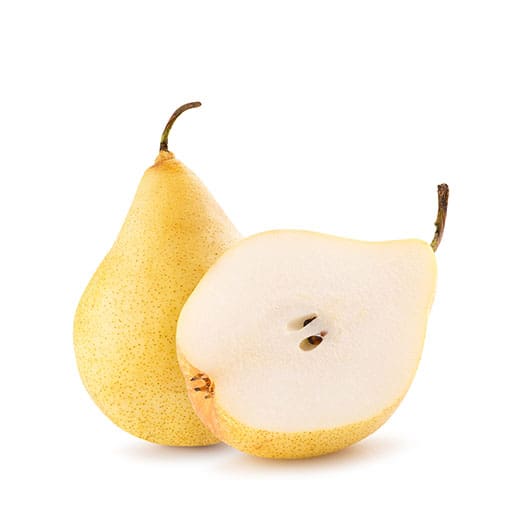
Pears are the most misunderstood fruit in the produce aisle — and that's exactly why our program matters.
Unlike apples, pears are picked when firm and ripened off the tree. If left to ripen on the branch, they develop a gritty, mealy texture. Our crews carefully time the harvest using pressure testing and sugar readings, then cool the fruit rapidly to "put it to sleep" until it's ready to ripen.
The Yakima Valley's combination of volcanic soil, long summer days, and cool mountain-fed irrigation creates pears with exceptional sweetness and a silky, butter-soft texture that commodity operations can't replicate. From the classic canning Bartlett to the elegant Comice, every variety we grow has a purpose and a following.
Most people eat pears at the wrong time. Here's the simple four-step method we recommend.
Choose pears that are firm to the touch with no visible cuts or deep blemishes. Surface russeting is natural and doesn't affect quality.
Place firm pears in a fruit bowl at room temperature. Check daily — most varieties ripen in 3 to 7 days. They ripen from the inside out.
Gently press near the stem end (the neck). When it yields to gentle pressure, the pear is ready. The wider bottom will still feel firm — that's correct.
Once ripe, refrigerate immediately. A chilled ripe pear will hold at perfect texture for 3 to 5 days. Don't wait — overripe pears turn grainy fast.
From the canning workhorse to the gift-box star, each variety has its own character.
Select a variety above to explore its flavor profile, best uses, and season.
The most widely recognized pear in America. Bright yellow (or red when sun-kissed), with a bell shape and incredibly juicy, sweet flesh. The gold standard for canning and an excellent fresh-eating pear when ripened properly.
Elongated with a distinctive cinnamon-brown russeted skin and a long, curved neck. Dense, honey-sweet flesh that holds its shape beautifully under heat — the preferred pear for poaching, baking, and roasting.
Egg-shaped with short necks, available in both green and red. Mildly sweet with subtle citrus notes and a smooth texture. Anjous are exceptional keepers — they maintain quality in cold storage for months.
Large, round, with green skin blushed pink. Incredibly lush, buttery flesh with a honey-vanilla sweetness that makes it the pear of choice for holiday gift boxes and cheese plates. Too delicate for cooking — meant to be savored fresh.
One of the smallest pear varieties, with a distinctive yellow-green skin speckled with red freckles (the name means "trout" in German). Crisp, sweet-tart, and wonderfully refreshing — perfect for lunchboxes and kids.
The smallest commercially grown pear — barely bigger than a golf ball — but packing the highest sugar content of any variety. Deep maroon skin over olive green. Intensely sweet with spicy undertones. Ideal for pickling, canning whole, or as a garnish.
Strikingly beautiful deep crimson skin with a smooth, symmetrical shape. Soft, silky flesh with a mild, floral sweetness and very subtle acidity. Stunning on a cheese board — the visual contrast with white cheeses is extraordinary.
A cross between Comice and Conference, inheriting Comice's sweetness and Conference's firmness. Tall, elegant neck, green skin that sometimes develops a faint blush. Uniquely, it maintains some crispness even when fully ripe — a rare quality in pears.
Pears shine in both sweet and savory dishes — their delicate flavor is remarkably versatile.

Sliced ripe Comice paired with aged blue cheese, honeycomb, candied walnuts, and crusty bread. The classic combination that never fails.
View Recipe
Firm Bosc pears gently poached in red wine with cinnamon, star anise, and orange peel until tender and deeply flavored. Served with vanilla mascarpone.
View Recipe
Sliced Forelle pears over peppery arugula with shaved Parmigiano, toasted pecans, and a lemon-shallot vinaigrette. Light, elegant, and ready in minutes.
View Recipe
Pears are one of the highest-fiber fruits available, with most of the fiber concentrated in the skin. They're also an excellent source of vitamin C, vitamin K, potassium, and antioxidants.
Unlike apples, pears demand a different approach. Get it right and you'll never go back.
Leave firm pears on the counter in a bowl. They'll ripen in 3 to 7 days. Place them near bananas to speed things up — bananas emit ethylene gas that accelerates the process.
Cold temperatures halt the ripening process permanently. If you put a firm pear in the fridge, it may never soften properly. Always ripen first, then chill to hold.
Pears ripen from the inside out. By the time the wide bottom feels soft, the inside may be overripe. Press gently near the stem — when it gives slightly, it's perfectly ready.
Pears bruise incredibly easily. Store them stem-end up, not touching each other if possible. Handle gently at the store — a bruise you can't see will turn into a brown, mushy spot.
A ripe pear at peak texture has a window of maybe 1 to 2 days at room temperature before it starts to decline. Pop it in the fridge the moment it passes the neck test for 3 to 5 extra days of perfection.
Can't use them in time? Peel, core, and slice, then toss with a little lemon juice to prevent browning. Freeze in a single layer on a sheet pan, then bag. Perfect for smoothies, baking, or sauce.